

Late July and August: the least Sports!-y section of the sports calendar. However, Sports! The Newsletter will not stop. (OK, I’m gonna stop for a little bit when I go on vacation in a few weeks, but you get the point.) We’ll be pumping out two newsletters a week about the sports you follow and the sports you don’t.
If there’s an upcoming event you’d like me to be aware of, PLEASE let me know in the comments or by emailing [email protected]. I don’t inherently know about every sporting event happening on Earth, and it’s massively helpful when you guys let me know what you want me to write about.
And I’m even more likely to write about it if you’re one of the people who has decided to pay for this free newsletter! Here’s the link.
– Rodger Sherman

Today’s Lineup
The mile record stood for 27 years … I don’t think it’ll take that long to break it again
A guest preview of the final three stages of the Tour de France!
A rant about NBA owners using the second apron as an excuse to be cheap

A Milestone Mile

Scotsman Josh Kerr set one of the oldest, most famous records in track, running the mile in 3:42.66 in front of a packed house in the London Olympic Stadium:
Kerr had his sights set on the mile record, training specifically to break it. We might not see the record stand for long.
Numbers in running can sometimes be abstract, but Kerr ran a mile, and as Americans, we should be pretty familiar with the concept of “miles per hour.” Kerr ran 16.17 miles per hour. Treadmills generally crap out after 15 mph.
Kerr says he lost his hearing for the last 100 meters, which apparently happens to him somewhat regularly. “It’s a very calming sensation, a trigger … as soon as it happens, it is my body telling me everything I don’t need is shutting off, and I’m going to get to the line as quickly as possible.” It’s a bit of a bummer in this case, though: he deserved to hear the crowd roaring.
Kerr pulled off the record with terrifying consistency. His 400m splits were 55.3, 55.8, 55.4, and 54.9 seconds. His final seven 100m splits were all between 13.7 and 13.9 seconds.
Can I claim this record for America? Sure: Kerr went to the University of New Mexico, and lives and trains at elevation in Albuquerque. New Mexico has one of the best distance running programs in the country. The men’s team finished second at this year’s NCAA cross country championships and won a handful of NCAA track championships.
And who can forget that Kerr took silver in one of my favorite races of the 2024 Olympics, when Cole Hocker won gold with a late kick.
Everybody knows about Roger Bannister’s famous four-minute mile, but Bannister’s record only held for about six weeks before it was broken by Australia’s John Landy, and would go on to be broken eight times in the next 15 years.
Kerr just broke a record that stood for 27 years. In fact, nobody had run faster than Noah Ngeny, the second-place finisher in Hircham El Guerrouj’s world record race, until Kerr did it this weekend.
Kerr targeted the record, calling his training “Project 222,” since he was trying to run the mile in 222 seconds.
Why had the mile record stood for so long? For one, it’s not a common race. The mile is a really arbitrary measurement — 5,280 feet, or 1,609.344 meters. It doesn’t fit cleanly into a 400m track. You can see that the race organizers had to tape on some of the starting lines for the competitors in London:

A few major mile races (the Bowerman Mile in Oregon, the Dream Mile in Oslo, the indoor Wanamaker Mile in New York) are held every year, but the event isn’t held at most Diamond League meets, the Olympics, or World Championships.
Even here in America, the mile doesn’t get run that often. The NCAA track championships used to hold a mile race three out of four years and then swap to the 1500m in Olympic years. But the 1500m is about 100 meters shorter than the mile — 109.344 meters, but who’s counting — and times varied wildly depending on the year. American track went metric for good in the 1970s.
(BTW, isn’t it weird they use miles in the UK? I feel like I’ve heard so many British people try to dunk on Americans for our stupid measurements, but they’re still putting off the switch to kilometers while using metric for basically everything else?)
And if you’re used to running 1500m, running an extra 100 meters (109.344, but who’s counting) has to feel bewildering to your body. For a longer race like the 3000m and 5000m, you’re likely pacing yourself and then kicking for a near-sprint finish. But the 1500m is about as long as runners can sustain a flat-out pace.
Then, when running a mile, they have to do that for another 100 meters. It makes sense that that extra 100m is when Kerr’s body decided to throw hearing out the window.
But I suspect we won’t have to wait 27 years for the next record. We’ve seen a few different mile records fall in the last few years: Faith Kipyegon set the women’s record in 2023, and the indoor record fell twice in two weeks in 2025.
🇫🇷🚵⛰️ To the Alps! 🇫🇷🚵⛰️

Delightful news: The editor of Sports!, Louis Bien, works in cycling and gets really excited about cycling. He asked if he could hop in to tell us about the present, and future, of the Tour de France.
Take it away, Louis! — RS
Tadej Pogačar is going to win the Tour de France. Good for him: He's probably the GOAT of cycling, seems like a nice guy as far as mega-star athletes go (crypto ties and all), etc. The problem with witnessing absolute dominance in cycling, though, is that it looks a lot like a guy riding a bike by himself. If all you care about is the yellow jersey, then this year's Tour de France has been a slog since about Stage 3, when Pogačar first demonstrated that he is fathoms faster than his next closest competitors.
But we're not here to talk about the yellow jersey. We're here to talk about two much more exciting subplots at this year's Tour: the green jersey and the white jersey.
The green jersey — or the maillot vert — goes to the rider who accumulates the most points at the Tour de France. Points are awarded for winning or placing highly on stage finishes, as well as on each stage's intermediate checkpoint. Point totals are weighted more heavily towards stages with flatter profiles, thus generally rewarding more powerful, sprinter-y riders, and ensuring that Pogačar doesn't just auto-win the competition by being the most dominant climber.
The green jersey competition receives much less fanfare than the yellow jersey competition, but some teams at the Tour de France approach it with the same amount of focus and resources as if they were trying to win cycling's most famous prize.
And this year, the green jersey competition has been a banger. Initially, it looked like Mads Pedersen of Lidl-Trek would walk away with it, taking a commanding lead during the second week. Not only is he a strong sprinter, but he's also a solid-enough climber to get well ahead of his competitors on lumpy stages and gobble up all the points at the intermediate sprints, essentially uncontested.
But late in the second week and early in the final week, Jasper Philipsen of Alpecin-Premier Tech found his legs and chipped away at Pedersen's lead, pulling within seven points after a win on Stage 17. (It's now a not-insurmountable 32 points after Stage 18.)
Long story short: Philipsen's comeback sets up what could be one of the most exciting final stages of the Tour we've seen in a long time.
Stage 21 is historically a glorified parade to the finish line, with the overarching prizes largely determined and everybody ready to be done riding their bike. But with a maximum of 75 green jersey points on offer for the stage — 25 for winning the intermediate, and 50 for the stage win — Philipsen, Pedersen, and their teams will be racing hell-bent to secure the green jersey.
It should be advantage Pedersen. He'll enter with a cushion in the standings, and the relatively hilly profile, climbing Montmartre three times before the traditional flat-out sprint on the Champs-Élysées, suits him well. But Philipsen is the faster rider if the race comes down to a head-to-head sprint. Factor in the setting — the most famous avenue in one of the most beautiful cities in the world — and you have the makings of a fireworks finale to one of the lengthiest and most grueling races in the world.
Before that, though, we should see the white jersey competition (and the two podium places behind Pogačar) decided on two massive mountain days finishing on the famed Alpe d'Huez.
The white jersey — maillot blanc — goes to the best young rider (under 26) at the Tour de France. This year, that battle happens to be between the third- and fourth-place riders on the overall standings. It feels like a battle for the future of the Tour.
The current white jersey-wearer: Mexico's Isaac del Toro, who is also Pogačar's teammate on UAE Team Emirates XRG. (The UAE squad is loaded; your Bama/Yankees/PSG/etc. equivalent.)
The 22-year-old won Stage 2 and has finished Top 3 five times, which is especially impressive because he's been riding in support of Pogačar, often gassing himself to give Pogačar his wheel. Del Toro will be a favorite to win the Tour de France when/if Pogačar starts to slip and/or decides he's done with it.
But he may never receive a fraction of the attention as 19-year-old Paul Seixas: France's great hope to end what is now a 41-year drought without winning the yellow jersey.
Seixas is already one of the fastest riders in the world as a teenager. During the spring, when cycling's biggest one-day races take place, he was one of the few riders to threaten Pogačar's dominance, taking second to him at Strade Bianche and Liège-Bastogne-Liège, two of the most prestigious races of the year.
Seixas' decision to ride the Tour this year was somewhat controversial. Many people rightfully questioned whether a 19-year-old would be mentally and physically ready to handle three weeks of the most intense racing on offer in cycling, especially in his home country where the media attention would be unrelenting.
But Seixas has handled the Tour with aplomb. The key indicator is the third week. Until the Tour, Seixas had never competed in a race longer than eight stages. He'll nearly triple that workload by the end of the Tour, and his fourth-place finish in Tuesday's time trial (five seconds ahead of Del Toro) suggests he has the legs to go the distance.
Stages 19 and 20 are two of the hardest days of this year's Tour, both finishing on Alpe d'Huez. (Each day will go up a different side of the mountain.) Behind Pogačar, all eyes will be on Del Toro and Seixas to see how the youngsters mark each other and handle the pressure and difficulty of two brutal stages with roughly 1,800 miles of racing already in their legs.
After Stage 18, Del Toro leads Seixas for the white jersey by just 20 seconds. Given the time gaps that are likely to open up on the mountain slopes, that difference is effectively a draw. There's a chance that the two riders end up 2-3 on the podium in some order. Whoever wins will score the first blow in what could be the next great rivalry of the Tour de France.
💸 A second about aprons 💸

This has been the wildest NBA offseason I can remember. But the tenor of NBA offseason wildness has pivoted over the last, oh, 20 years.
Some things haven’t changed (we are still waiting on LeBron James to decide where he wants to play, although the Miami Heat youtube channel may have given it away) but we now spend less time talking about the personalities of players and more time discussing finances.
Whether teams are trading away their stars or illegally circumventing the NBA’s salary cap rules, it’s been impossible to be a basketball fan this summer without hearing about the salary cap on a daily basis. The much-dreaded “second apron” is talked about like a bogeyman that stalks you when your team’s salary exceeds 221 million. (That’s a link to a deeply accurate, terrifying salary cap game.)
I wanted to rant about something.
The biggest story of the NBA offseason to me is that nobody knows what is going to happen with Kawhi Leonard, whose trade to the Toronto Raptors is on hold pending the results of the investigation into the Clippers’ alleged attempts to manipulate the salary cap by paying him side money through fake endorsement deals.
A quick timeline: Pablo Torre’s podcast uncovered the scandal on Sept. 3, 2025, and the NBA quickly hired an external law firm to conduct an investigation. At the NBA Finals in June, commissioner Adam Silver announced that the nine-month old investigation was “far along.” On June 30, the Raptors traded for Leonard. On July 9, the Raptors announced they are putting the trade on hold because Leonard could be punished for the scandal. (It would be dumb to give up valuable assets for a player who could be suspended, or whose contract could be voided.) Silver then followed up to say that he expects the investigation to wrap up this summer.
HOW LONG IS THE SUMMER, ADAM?!?!?!?!?!!?
Does he mean “the end of the offseason?” Does he mean Labor Day? Does he mean the autumnal equinox? Does he mean when he gets back from the beach?
Leonard is still great — he finished seventh last season in MVP voting, sixth in points per game, and fifth in PER — and the Raptors could legitimately be the best team in the Eastern Conference if they pull off this trade. But we don’t know if they’re going to do that because lawyers are still racking up billable hours.
The second-wildest thing to happen this NBA offseason is the Celtics trading Jaylen Brown for Paul George and an unimpressive haul of draft picks. Brown finished fourth in points per game and sixth in MVP voting, while George finished 69th and n/a. From a basketball perspective, everybody agrees that the Celtics downgraded.
The Celtics made it clear that their motivations were financial: Executive Brad Stevens said the team’s path to a championship was “challenging with 70 percent of the cap and such a high percentage of our usage tied up in two players.” The Celtics, who were recently purchased by a private equity executive and a private equity firm, were more concerned with the team’s long-term finance sheets than their ability to win the title in 2027.
Even for Knicks fans celebrating the first NBA championship of our lifetimes, the tone of the offseason quickly changed when it became clear owner James Dolan wouldn’t be maintaining the roster, saying that, from a team-building perspective, “you’d have to be suicidal” to go into the second apron.
Afterwards, the Knicks let Mitchell Robinson, the team’s longest-tenured player and one of the best offensive rebounders in NBA history, leave in free agency for the Celtics.
Don’t worry, I’ve still managed to spend most of the last month wearing Knicks championship gear and yelling WE DID IT at other people wearing Knicks championship gear.
(We did it.)
You might think from the way teams and media talk about the second apron that it’s illegal to surpass that $221 million figure. It’s not! Teams can do it! They just don’t want to.
I don’t buy the idea that it’s “suicidal” to go into the second apron! Sure, it comes with a handful of restrictions that make it harder to build a roster — second apron teams can’t sign-and-trade players, use certain salary cap exceptions, trade draft picks seven years in the future, and more — but they’re not team killers. And besides, those restrictions are somewhat irrelevant for teams like the Knicks or Celtics that already have competitive rosters.
The “second apron” talk buys cheapskate owners cover for their unwillingness to spend on winning teams. The real reason people like James Dolan and the Celtics’ private equity owners are unwilling to go past the second apron is because it comes with significant financial penalties. But they can cite obscure, tough-to-parse basketball ramifications and make their savings sound savvy.
When the NBA’s players’ association agreed to the second apron — a decision it now regrets — it probably assumed relatively minor off-court penalties wouldn’t prevent teams from making these moves.
The positive is that teams’ unwillingness to stack stars has increased league parity. The Celtics are undoubtedly worse because of the Brown trade, and there’s been a new champion each of the last eight seasons, including the Knicks this past June.
(WE DID IT!)


🥎💨🔥 Bat Breaker 🥎💨🔥
The wildest thing I have seen in sports in months: Karlyn Pickens of the Carolina Blaze in the AUSL breaking two metal softball bats with her pitches in the same week:
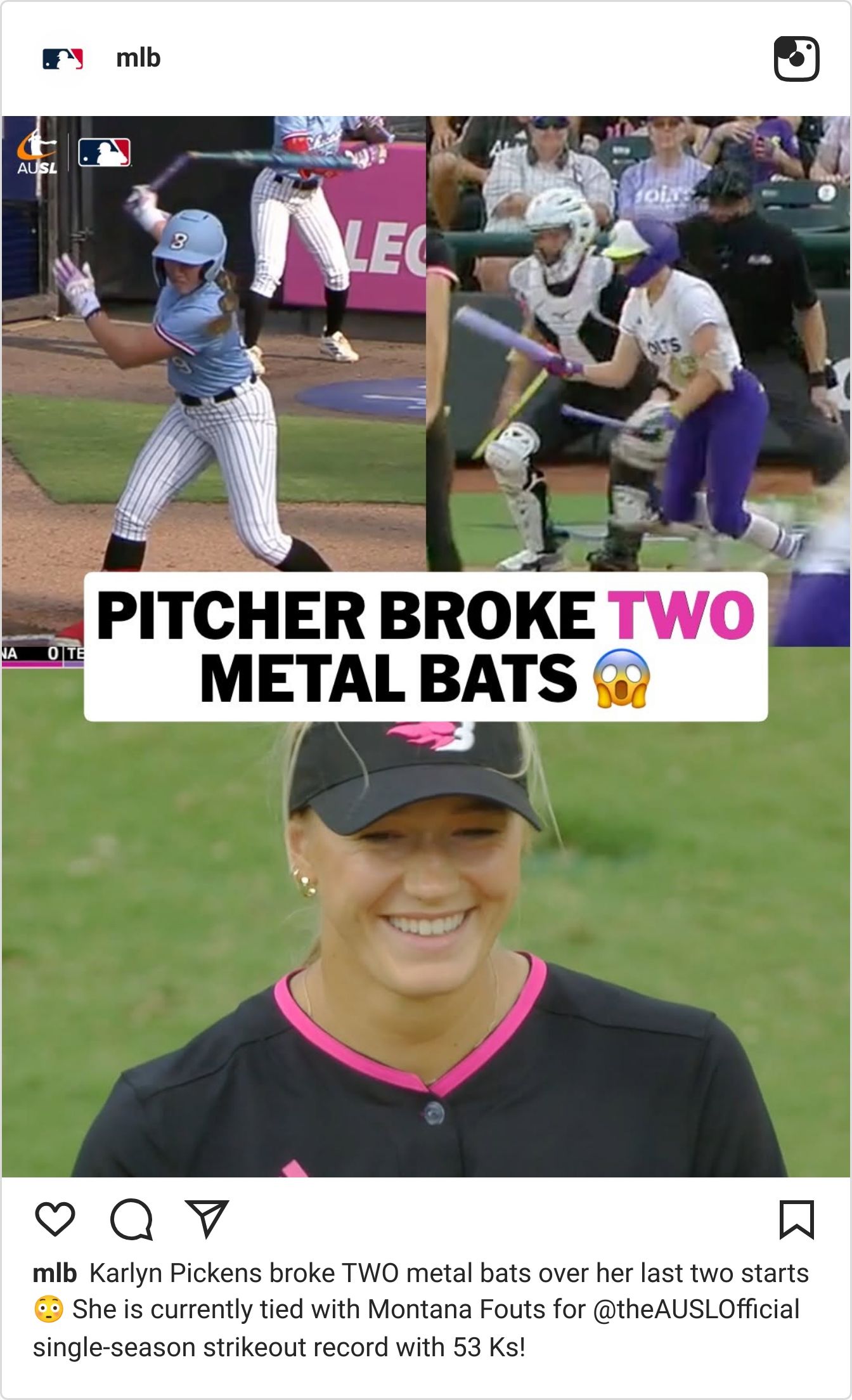
Pickens set the record for the fastest softball pitch ever at 79.4 mph while she was at Tennessee; the ball reaches the plate in the same time a 110 mph pitch would reach the plate in baseball. The bats she broke look like they’re made of multiple pieces of metal, and she’s getting them to snap — I’d never seen that before!
A rookie in the fledgling AUSL, Pickens finished second in the league in strikeouts, but the Blaze didn’t reach this weekend’s playoffs. (Which we’ll talk about more in the On Deck section!)
🦊⛳️🥝 Fantastic Mr. Fox 🦊⛳️🥝
New Zealander Ryan Fox won the Open Championship with a birdie on 18. The son of a rugby player and grandson of a cricketer, Fox had never finished in the Top 15 at a major. It’s a time of parity in golf: Four different golfers won majors this year, and the Open has been won by 13 different golfers in its last 13 tournaments.
Here’s my potentially bad take: This course is too easy! Three golfers — Fox, Sam Burns, and Lucas Herbert — carded a 62 at some point in the tournament, each tying the lowest round ever shot in a major. They’re tied for the all-time record with five other golfers … including Branden Grace at the 2017 Open, also at Royal Birkdale!
🚫🤚🚫 No hands! 🚫🤚🚫
Soccer doesn’t end with the World Cup — in fact, the early stages of European competitions, between the best teams from Europe’s smallest countries, actually took place during the World Cup, leading to a truly absurd lowlight.
In a UEFA Conference League qualifier between Malta’s Hamrun Spartans FC and the Faroe Islands’ NSÍ Runavík, the Spartans lost when one of their players mistakenly thought the ball had gone out of bounds and used their hands to place the ball for a goal kick. The result was a penalty kick in the 91st minute and a win for Faroese side
On the one hand … it looked like the ball did, in fact, go out of bounds, and the refs should’ve just given a goal kick.
On the other … you’re a soccer player, couldn’t you have stopped the pass and set the ball with your feet?
🚩🚴💨 Extreme wind cancels extreme sport 🚩🚴💨
A very early test for the 2034 Brisbane Olympics didn’t go particularly well: The quarterfinals, semifinals, and finals of the UCI BMX Racing World Championships were canceled due to high winds, which can be a pretty big problem for bicyclists flying through the air. The world title went to the racers who had the fastest times in the 1/8th finals: Australia’s Jesse Asmus and Great Britain’s Beth Shriever. Shriever is a four-time World Champ and won Olympic gold in Tokyo; Asmus had never medaled at a World Championships and said he raced especially hard in the preliminary rounds knowing the rest of the races might get canceled.
RIP, Hannah Rapp
Awful news from the world of boxing, as up-and-coming title contender Hannah Rapp was killed in a senseless road range incident in Texas. She was riding a bicycle with her boyfriend when a driver allegedly drove past the couple, stopped his car, and accelerated in reverse into Rapp. Rapp had just fought for the world featherweight title last month, her first title shot.


On Deck is written by Bradley Locker
🌟🏀 WNBA All-Star Weekend 🏀🌟
Events on Friday, 7 p.m. ET (ESPN). Game on Saturday, 8:30 p.m. in Chicago (ABC)
The game’s best and brightest will take their talents to the Windy City for the league’s annual All-Star festivities … and “the best and the brightest” does not include any players on the Chicago Sky, who have nobody in the hometown All-Star Game, or any of the events.
The weekend get started with the three-point contest on Friday, featuring rookie Azzi Fudd but conspicuously not sharpshooters Caitlin Clark and Sabrina Ionescu. Then, the Shooting Stars competition will include several legends, such as Hall of Famers Elena Delle Donne and Lauren Jackson, paired with up-and-coming players.
On Saturday, Team Spoon takes on Team Coop in the actual All-Star game, and I think Teresa Weatherspoon outdrafted Cynthia Cooper: She got A’ja Wilson, Caitlin Clark, and rookie phenom Olivia Miles.
🥎 AUSL Playoffs Championship 🥎
Play-in on Thursday, 9 p.m. ET (ESPN). Championship series starts Saturday, 1 p.m. ET, in College Station, Texas (ABC)
After tying for first place in the regular-season standings, the reigning champ Utah Talons clinched their spot in the title series for the second-straight season. They await the winner of the Chicago Bandits and Portland Cascade in Thursday’s play-in bout. Utah’s pitching is dominant. The Talons have league ERA leader Georgina Corrick (1.12) — who threw a complete game on Sunday against Chicago after flying 10 hours back from representing Team Great Britain in Peru — and league strikeout leader Montana Fouts (63).
🤺 World Fencing Championships 🤺
Finals begin Saturday in Hong Kong (Fencing TV)
We may be two years away from Olympic fencing returning in full force, but this weekend will be a nice amuse-bouche. (Fencing people like French words.) The championships run through next week. This weekend features two events in which Hong Kong could win at home: Ryan Choi is the reigning champion in men’s foil, and Vivian Kong won gold at the Paris Olympics in women’s épée. Meanwhile, Sunday has the men’s épée individual final and women’s sabre individual final, with the former headlined by 2024 gold medal winner Koki Kano of Japan.
🚴♂️🥖 Tour de France 🥖🚴♂️
Stage 19, Friday: Gap to Alpe d'Huez, beginning at 7 a.m. ET (Peacock). Stage 20, Saturday: Le Bourg d'Oisans to Alpe d'Huez, beginning at 5:30 a.m. (Peacock/NBC). Stage 21, Sunday: Thoiry to Paris Champs-Élysées, beginning at 9:30 a.m. ET (Peacock)
See the big entry above. It’s going to be a fun three days of racing, provided you’re not very invested in the yellow jersey.
Bradley’s baseball pick:
☀️ Rays ☀️ vs. 🔺 Guardians 🔺
Starts Friday, 7:10 p.m. ET in Cleveland (MLB.TV/Peacock)
Of all the series to monitor around the big leagues this weekend, this one feels the most pertinent. Both clubs occupy a playoff spot and have at least a 68% chance of getting to late October according to FanGraphs, making this a possible ALDS preview. Cleveland’s below-average offense will be challenged by three elite Tampa pitchers in Shane McClanahan, Nick Martinez, and Drew Rasmussen, although the return of José Ramírez from a broken hand should be a lift. Sunday, in particular, looks like a dandy of a pitching matchup between All-Stars Parker Messick and Rasmussen.
🇭🇺🏎️ Hungarian Grand Prix 🏎️🇭🇺
Sunday, 9 a.m. ET in Mogyoród, Hungary (Apple TV)
There’s been almost no stopping 19-year-old Kimi Antonelli, who claimed his sixth win of the season by prevailing in Belgium last weekend. Antonelli is favored yet again to win on the Hungaroring track, but Lewis Hamilton looms with eight career wins at the venue (although his last one came in 2020).
Thank you for reading and for your support!
⚙️ I write roundups about the NFL, college football, college basketball, and the Olympics. You can turn individual sports on or off via ‘Manage Profile’ in the top-right corner.
💬 I love reading your comments! Feel free to leave one here.
😎 Enjoy this column? Become a Sports! Enthusiast for $8 a month.
🔔 Was this sent to you? Well then, here’s your link to subscribe.


