

Halloween college football is great, because sometimes the fans storm the field and the players are out there celebrating with Big Bird.
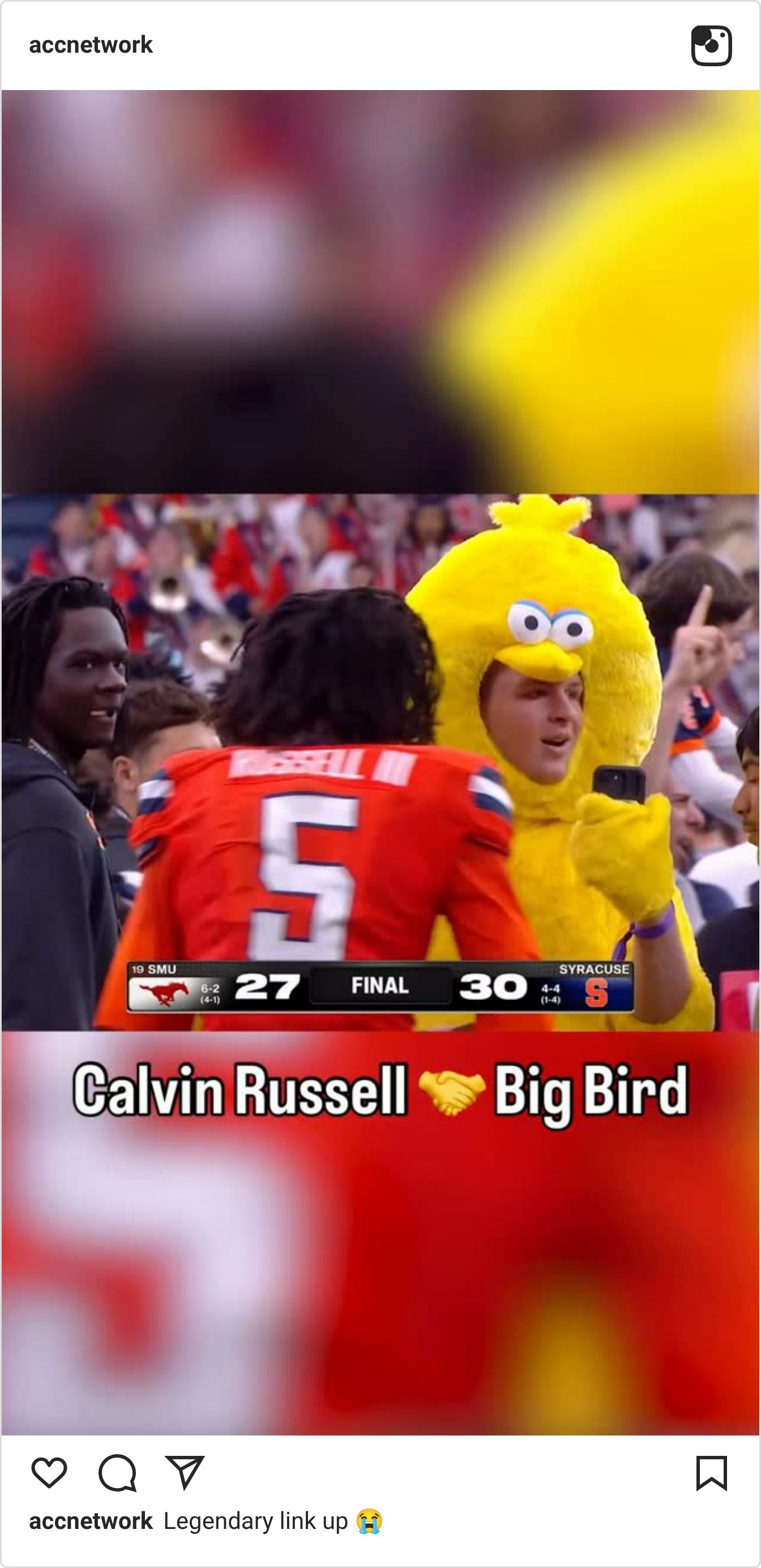
– Rodger Sherman

Today’s Lineup
Minnesota-Indiana made history with two 60-yard field goals in the same game
Lincoln Riley and USC are
so overso backDiving deep into the rulebook and history books to talk about Saturday’s game-winning fair catch kick

🦶🦶🦶 IT’S GOOD X2 🦶🦶🦶

ψ Indiana 23 ψ
🐿️ Minnesota 16 🐿️
Saturday brought us the greatest kicking shootout in football history.
With 16 seconds left in a tied game against No. 4 Indiana, Minnesota kicker Luke Drzewiecki lined up for a go-ahead 60-yard field goal and drilled it. He stuck it right between the pipes, with room to spare, to give his team a stunning lead over the defending national champions.
It was the second-longest kick in the preposterously long history of Minnesota football, and the second-longest would-be game-winning kick in college football history — an iconic moment that would ensure Minnesotans could spell “Drzewiecki” for decades to come.
And then, as time expired, Indiana’s Paddy McAteer drilled a 60-yard field goal of his own, sending the game to overtime with the longest kick in Indiana history:
There were as many 60-yard field goals in the final 20 seconds of this game as there were in the NFL from the time of its formation until 1990. That’s a real stat!!! This game was quite possibly the first in football history to feature two teams hitting 60-yard field goals, and they did it within 20 seconds of each other.
(Then Indiana won in overtime. That seems to be normal at this point.)
Once upon a time, the kicker was a finicky, unreliable mini-man at the end of the bench who couldn’t be counted on to fulfill his limited duties. In 2026, kickers have transformed the sport with their tremendous skill and power. We’ve seen kickers like Brandon Aubrey and Cam Little become must-watch players in the pros. Now the SuperKicker era has come to college.
I really do think there has never been a game in which both teams hit 60-yard field goals. It’s never happened in college football, and it’s never happened in the NFL. When there were two 60-yarders in the same week last October, that was considered notable. (I guess it could have happened in high school or the CFL or something, but I don’t think that’s particularly likely.)
(There was a college football game in which one kicker had two 60-yard field goals by himself: Texas A&M’s Tony Franklin in 1976. Franklin’s performance was helped by the fact that kickers could use tees on field goals back then, but made more difficult by the fact that Franklin insisted on kicking barefoot, and did so throughout a lengthy NFL career.)
Let’s celebrate our two heroes. Drzewiecki is at Minnesota after four years at New Mexico; he enrolled with the Gophers in August after all college football players were allowed to play a fifth season. He never hit a 50-yarder with the Lobos, which explains why he didn’t get an NFL job. At Minnesota, he’s currently 15-for-15 on the year with three kicks from 50 or more, so there’s a good chance he’ll get a look from the pros.
McAteer is a converted Gaelic football player from Ireland brought in to handle kickoffs after two years in the same role at Troy. McAteer never beat out starting kicker Nico Radicic for the starting job kicking field goals, but he has been brought in a few times to kick from distance due to his big leg … and had missed every time — from 54 against Western Kentucky, and from 56 against Michigan. He says he doesn’t even practice from 60.
There’s a wave of Irish kickers these days, most notably Charlie Smyth of the Saints. I’m not quite sure why they’re thriving — Aussie Rules football has produced so many punters because the game is almost completely built around punting an oval-shaped ball, but Gaelic football is played with a round ball that you don’t kick off the ground — but they’re clearly catching on.
There’s actually an island-wide field goal kicking competition for Irish kickers that will culminate in a showcase at halftime of Northwestern’s game against Iowa next week.
(No I don’t know why they picked Northwestern.)
“College kickers” used to be a meme. In a short amount of time, they’ve improved exponentially. In 2016, college kickers combined to hit 59 total 50-yard field goals. In 2026, they’ve made 106 with an entire month of the regular season and the whole postseason to go.
Every drive is a scoring drive when kickers can stroke it from 60. How many games have we seen where the result flips in the final seconds because it only takes a play or two to get into the ever-expanding range of our SuperKickers?
I get romantic about incredible kicking performances because I think they tell us something about human progress. When watching a game, it’s easy to forget that everybody has gotten better at everything: quarterbacks are better than ever at throwing, but cornerbacks have gotten quicker and defensive ends have gotten more explosive, and the gains pretty much cancel out. With kickers, though, the uprights have remained the same for years, so we can easily track their steady upward progress as they bomb kicks from deeper and deeper. It makes you wonder: What else have we gotten better at over the decades?
Also: It’s fun to watch somebody kick the living hell out of the ball. That’s also pretty cool.
👀 You Can USC Everything 👀

✌️ USC 30 ✌️
🌰 Ohio State 18 🌰
USC is the It’s So Over/We’re So Back Team of the Year.
Last week, the Trojans lost a game that seemed like the death knell for Lincoln Riley. USC fell 24-7 to Wisconsin, and scored the fewest points by any team Riley has ever head coached. In Year 5 after hiring Riley, a supposedly transformative move meant to push the stagnant Trojans back into the spotlight, USC wasn’t winning … or even scoring points, the one thing Riley teams always do.
Then Saturday, the Trojans posted highlight after highlight on the No. 2 Ohio State Buckeyes for the signature win of the Riley era. Here’s freshman tight end Mark Bowman turning a hurdle into a truck in what might be the best run by a USC player since Reggie Bush:
I never would’ve picked this upset. Everything I know about Lincoln Riley’s USC and everything I know about Ohio State led me to believe this was going to be an easy rout for the juggernaut Buckeyes. USC was 0-5 against top-10 opponents under Riley. Ohio State was 58-1 against unranked opponents under Ryan Day … and 58-0 against unranked opponents that weren’t Michigan. (They got pretty deep in their heads about that one loss.)
What’s most exciting about the result, honestly, might not have anything to do with Riley. Boweman’s TD was by an elite freshman tight end prospect out of Mater Dei, the powerhouse program in Orange County. And this 69-yard touchdown on a screen came thanks to a huge burst of speed by Trent Mosley, a top freshman receiver prospect also out of Orange County:
Those two plays exemplified the promise of USC football — that a team built out of Southern California’s best talent can do some pretty incredible things.
Normally I’d assume “well, the backup QB screwed it up” for Ohio State, which is playing without starter Julian Sayin. But honestly, I don’t think Ohio State’s Luke Fahey was the reason the Buckeyes’ lost. He broadly accomplished the Ohio State quarterback’s job of “throw the ball to Jeremiah Smith.”
The College Football Playoff picture is pretty jacked up. Three of the preseason Top 5 have now lost multiple games. Just seven zero-or-one-loss power conference teams remain, and they pretty much control their destiny. (Yes, that includes teams like Wake Forest and Kentucky … but if they really make it to Selection Sunday with one loss, they’ve gotta be in.) Meanwhile, USC and Ohio State are now in the vast group of teams with two losses, along with Alabama, LSU, and Texas. Every week will be do-or-die for this bunch, making the situation a great advertisement for the 12-team playoff in its final season.
And the one Big Ten team that’s still undefeated? That’s USC’s Angeleno rivals, UCLA. Normally, the crosstown rivalry game between the Bruins and Trojans is more notable for its pretty uniform pairing than its on-field ramifications (stylish and vapid, the LA stereotype). But this year, it could be critical to the college football landscape.

🙋♂️ FAIR CATCH KICK! 🙋♂️

🐦 Johns Hopkins 31 🐦
🫏 Muhlenberg 28 🫏
Want another bizarre kicking thing that had never happened before in college football? Down in Division III, Johns Hopkins became the first team in 76 years to win a game on a fair catch kick, beating Muhlenberg 31-28 on a 39-yarder by Kaleb Wayt:
Perhaps you are wondering: What the hell happened here? Why has nobody else won a game this way? Since when is this legal? Why am I suddenly reading about Division III football?
Great news: I am the internet’s No. 1 Fair Catch Kick Enthusiast. (The working title of this newsletter before Sports! was Fair Catch Kicks! but it didn’t test well in focus groups.) This one weird play has been a pet obsession of mine for well over a decade. When the Chargers successfully converted a fair catch kick in 2024, I immediately logged on to explain every detail about fair catch kicks, the circumstances that cause them, and why the play is even in the rulebooks. Here’s that Chargers kick if you want it:
That post I wrote in 2024 is a good primer … but Saturday’s kick had a special twist.
Part of the reason nobody had won a college football game like this in 76 years is because fair catch kicks require an unusual set of circumstances. The other reason is that college football eliminated this weird play for decades, only to bring it back this season despite nobody asking for it.
OK, so, the fair catch kick. Quick summary: When a player receiving a kickoff or punt makes a fair catch, his team technically has two options for how to proceed. It can either take the ball on offense and try to score a touchdown, or it can kick a field goal from the exact yard-line where the fair catch was made.
In 99.99 percent of scenarios, you’re going to want the ball on offense. The .01 percent is what happened here: When the fair catch is made in field goal range, with so little time left that a touchdown drive is impractical, in a situation where a field goal will impact the outcome of the game.
Most fair catches are made well out of field goal range. It takes a particularly bad punt — one that doesn’t leave field goal range and also gets caught on the fly inbounds — to even make a fair catch kick possible.
The rule is derived from rugby. There’s a similar rule still present in Australian Rules football, demonstrating how American football and Australian football are branches on the same family tree. The rule basically sat, untouched, in the NFL rulebook for 100 years, along with rules about how to handle drop kicks and other depression-era football strategies.
College football removes some of its vestigial parts from time to time. In 1950, college football got rid of fair catches. The next year, the fair catch came back — I guess they realized it was somewhat important to give return men the opportunity to not get blasted to smithereens by the kicking team — but the fair catch kick was left out because it was so rarely used. According to Football Archaeology — a great free newsletter for people like us who care about weird stuff like this — rules committee chair Fritz Crisler “justified the decision by saying the free kick had been largely obsolete since the college game moved the goal posts to the end line in 1927.”
To be clear: The free catch kick is so outdated that people who watched football in 1951 thought it was an obscure rule with no place in the modern game.
Like, the fair catch kick was outdated in an era when the Cleveland Browns were good.
And then, out of nowhere, the people in charge of college football’s ruleset voted to bring back the fair catch kick in 2026.
Who was asking for this? Who thought college football was missing this thing that barely ever happens in the NFL? Is there a Big Fair Catch Kick lobbying group? Was it just one guy who saw the Chargers kick and thought “that was cool” and decided to bring it back?
… is it me? Did I will the rule change into existence by posting about the fair catch kick over and over again?
According to The Athletic, this was the first successful fair catch kick of the season at any level; Division III Montclair State attempted (and missed) one earlier this year. And according to Football Archaeology, it’s the first game-winning fair catch kick since Marquette beat Michigan State in 1939.
And yet, after all that, it might be just the second-weirdest kick ending to a Johns Hopkins win over Muhlenberg in the last few years: In 2023, a game-winning attempt by Johns Hopkins was blocked (perhaps due to a very loud, definitely illegal air horn blast right as the kicker hit the ball) only for the ball to bounce directly to a Hopkins tight end who ran in the kick for a game-winning touchdown:
This time, Muhlenberg didn’t have a chance to block JHU’s kick and it still lost. Damned if you do, damned if you don’t.

😈 Duke 47 😈
🦅 Boston College 2 🦅
A little bit of history here: BC got the two points on a defensive two-point conversion by returning a blocked extra point:
According to my own research, it was the first FBS game in which a team’s only two points came on a defensive two-point conversion since 2005, when Ohio State beat Illinois 40-2. Scoring all your points on defensive two-point conversions is a bad strategy, because even if you do it on every touchdown, it means the other team just scored six points.
Believe it or not, this was not the only 47-2 game in college football history. Believe it or not, Take 2: This was not the only game on Saturday in which a team scored all of its points on a defensive two-point conversion! In Division III, Chapman beat Pomona-Pitzer 35-2.
🐻 Baylor 41 🐻
🔭 UCF 9 🔭
🐺 NC State 31 🐺
🧸 Cal 10 🧸
Two of the three teams that fired their coaches last week got resounding wins. Go ahead, just fire your coach, it’ll fix everything! (Offer does not apply to the Maryland Terrapins.)


